Moisés
The Wizard's Apprentice
A documentary film by Thomas Fischermann & Giorgio Palmera
"My family has kept a secret since the beginning of time. Our men are trained to become Malirinai. My ancestors knew how to cure every illness and kill our enemies.
My world fell apart when I was five years old. The gold prospectors threatened us with violence. We moved to the city. Our village fell into ruin.
But there is a way to regain what has been lost. When I become a Maliri, I can help. Then I can heal illnesses and drive away the Yoopinai spirits. Only then can we continue to live in this world." — Moisés Baniwa · co-author & protagonist
The Urgency
One of humanity's worst crimes is being committed in the Amazon. The largest remaining contiguous rainforest is being destroyed — the planet's highest biodiversity, one of the last stabilisers for the global climate. Human cultures that have survived for millennia are being wiped out. Climate researchers predict the Amazon will reach a tipping point within years.
Traditional peoples still know how to coexist with nature without destroying it. Uprooted and resettled, the elders fall silent. Their stories die with them. Within two generations, millennia are erased.
Moisés grew up in the border region between Venezuela, Colombia and Brazil. Until the age of five he knew nothing but the traditional way of life of his people — steering a canoe, catching fish with spears, avoiding caimans, water snakes, venomous spiders. His world was steeped in magic. The men of his family stood in a millennia-old shamanic tradition.
Then came the shock: violent gold prospectors invaded their territory. The entire village had to move. The five-year-old Moisés was hastily initiated. His memories are fragmentary: beaten, forced to inhale tobacco smoke and sniff hallucinogenic substances. The elders whispered their secrets. But he was too young to remember much.
In the city the family settled near a rubbish dump and a factory. As an adolescent Moisés began to feel personally responsible: could he have secured a better life for his people if he had preserved the teachings of the elders?
To this day he lives on the outskirts of that city, disoriented. He has made a decision: go back.
Moisés wants to give his father one last gift: to experience the return of the whole family to their old home. It is a race against time.
Two goals drive Moisés. Rebuild. Reconstruct the shamanic house — an indispensable centre for his people's spiritual practice. Traditional building materials must be brought from distant regions: sturdy aroa vines, aromatic woods, sacred pigments, hidden stones. He cannot do this alone. Time presses, because his old, weakened father should still see the completed house and the initiation ceremony.
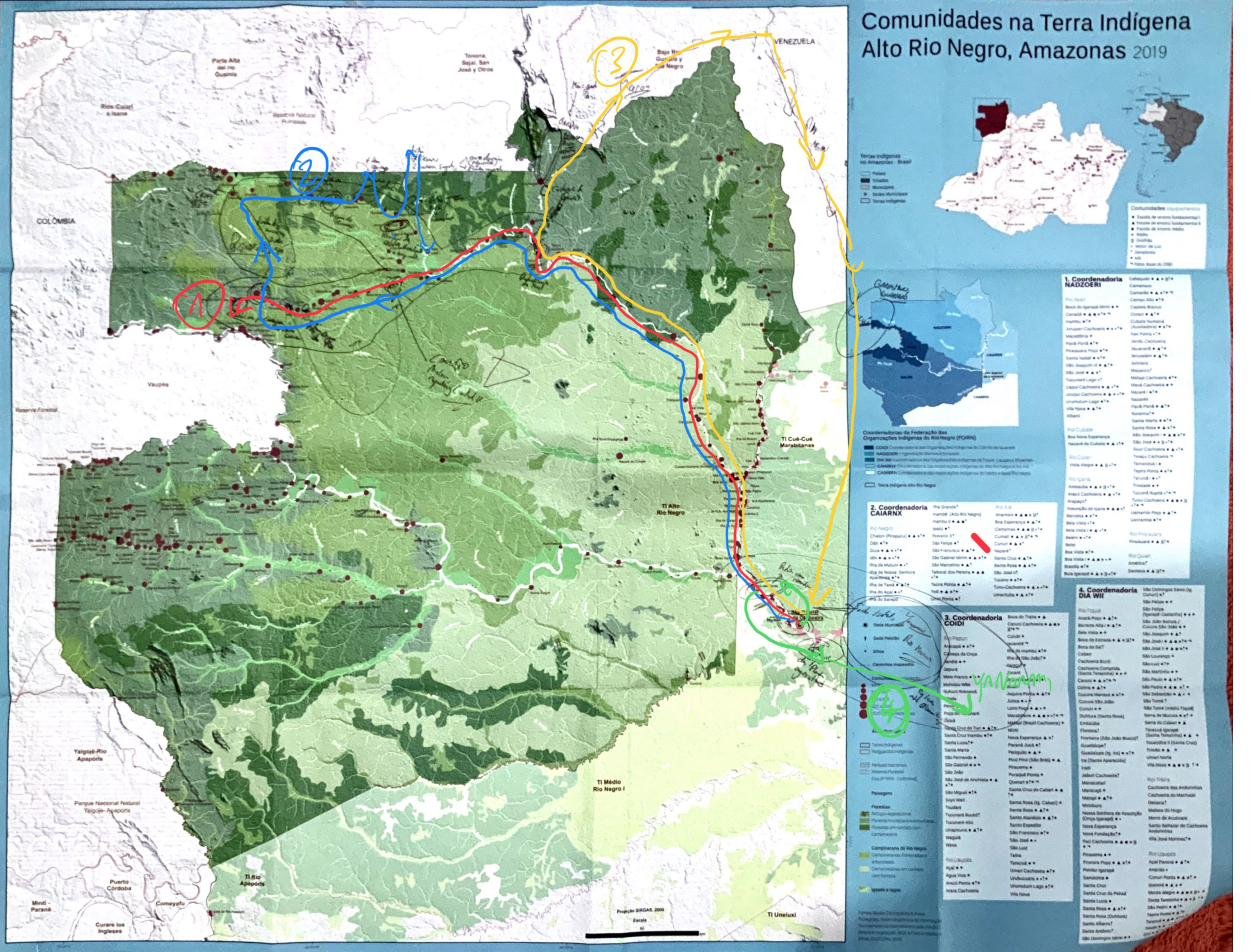
Transform. Complete his initiation as a Maliri shaman. The apprentice must traverse the lands of his ancestors using chants as guides, to find hidden rocks, caves, water sources. Many places are dangerous. Others are guarded by shamans from other peoples, some friendly, some hostile.
The film accompanies him on these journeys, both physical and spiritual. As Moisés delves deeper into the forest and simultaneously into his ancestral memory, the film invites viewers to discover the rich cosmology of the Baniwa — a system of knowledge in which plants, animals, rivers and spirits are interconnected.
Together with Moisés we discover what was once passed on in whispered chants and sacred rituals: not only how to heal the sick or survive in the jungle, but how to live in harmony with nature.
Does this ancient knowledge perhaps hold a vision for us all — at a time when our own relationship with nature has been broken?
"I Must Climb Cocuy"
"From my village it takes only two days by boat to reach the Serra de Cocuy, rising out of the rainforest. Its rock faces are steep and bare. For a man it is very difficult to climb up. But halfway up grow plants that have a special meaning for a Maliri.
I must go there — but not because of the plants. I want to verify if the story is true. A Maliri apprentice is expected to know such places. It makes a difference whether you have only heard about something, or seen it with your own eyes.
I will ascend. And see what is really up there."
Serra de Cocuy · tri-border Amazon
The film thrives on contrasts, and Giorgio makes them visible: the gap between the majestic river, forest and mountain landscapes of the Amazon and the desolate small town with its concrete, exhaust fumes and rubbish heaps; between the magic of shamanic rituals and the harshness of the struggle for survival. Not as exotic spectacle — but as a struggle for identity and survival.
Giorgio Palmera's images give the film its aesthetic soul: contemplative where Moisés immerses himself in the spiritual world; dynamic where he defends himself against destruction from outside. The camera breathes with the protagonist.
Slow and meditative in moments of spiritual search, nervous and driven in confrontation with the outside world. Its movements mirror Moisés' inner state: tension and relaxation, struggle and contemplation.
Stylised animations — based on drawings made by Moisés and other villagers themselves — make the unseeable visible: childhood memories, inner visions, encounters with spirits of the forest. Indigenous art that blends organically into the cinematic aesthetic.
- City ↔ Forest Motorcycles & cachaça versus river silence and jungle foraging — two irreconcilable worlds in one man
- Father & Son Guilt, accusation, reconciliation — a conversation decades in the making; which decisions were right?
- Serra de Cocuy Seven days of fasting, a dangerous cliff-face, half-delirious dialogue with ancestors
- Hipana The origin of the world — where all times converge. The village beside the sacred waterfall is hostile to his family
- Petroglyphs We will show places no camera has recorded before — rock carvings shamans call required reading for apprentices
- Sacred Pilgrimages The Piaroa, feared masters of dark arts. The Yanomami, known for colourful festivals
- Building the Shamanic House A community project — aroa vines, aromatic woods, sacred pigments, hidden stones
- The Destroyers Gold miners, soldiers, evangelical preachers — moments when destruction takes on a human face
Moisés harvests and prepares pariká — one of the most potent psychotropic substances known. Fire, songs, hand-rolled magic cigars and incantations are his companions. We witness the spiritual system of his people firsthand.
© Giorgio Palmera
Why Now
For Moisés, it is
already almost too late.
His father Luiz is ~85. His uncle and shaman teacher Mário is ~90. Every passing season brings the moment closer when the last carriers of this knowledge will be gone. Moisés does not have the luxury of waiting.
The Amazon is dying fast. The elders are falling silent. The window for this film — and for this story — is now.
A Story Told
From Within
"Moisés, his family and his village community tell their story themselves."— Thomas Fischermann, Director
- Moisés Baniwa is co-author of the screenplay — not a subject but a creator.
- Animations are based on drawings made by Moisés and community members — indigenous art woven into the film's visual language.
- Thomas Fischermann has co-authored two bestselling books with indigenous writers and launched the Rainforest Journalism Fund (Pulitzer Center, 2018). rainforestjournalismfund.org
Nilson Baniwa, 2020 · Rio Negro, Amazonas

MOISÉS
The Wizard's Apprentice
© 2026 Thomas Fischermann · All rights reserved · Strictly confidential